How to read a liquidation heatmap (and what most retail traders miss)
A liquidation heatmap shows where leveraged positions are likely to fail. Reading it well means understanding what it is not (a price target) and what it actually is: a map of forced liquidity that gets eaten when price arrives.
A liquidation heatmap is one of the most-misread tools in crypto. Half the retail audience treats it like a price target. The other half dismisses it as junk because their previous magnet-fishing trades failed. Both are wrong for the same reason: they read the heatmap as a prediction instead of a map. MarketTrace now draws one from its own open-interest and liquidation data: the BTC liquidation heatmap, with realized liquidations on the same grid.
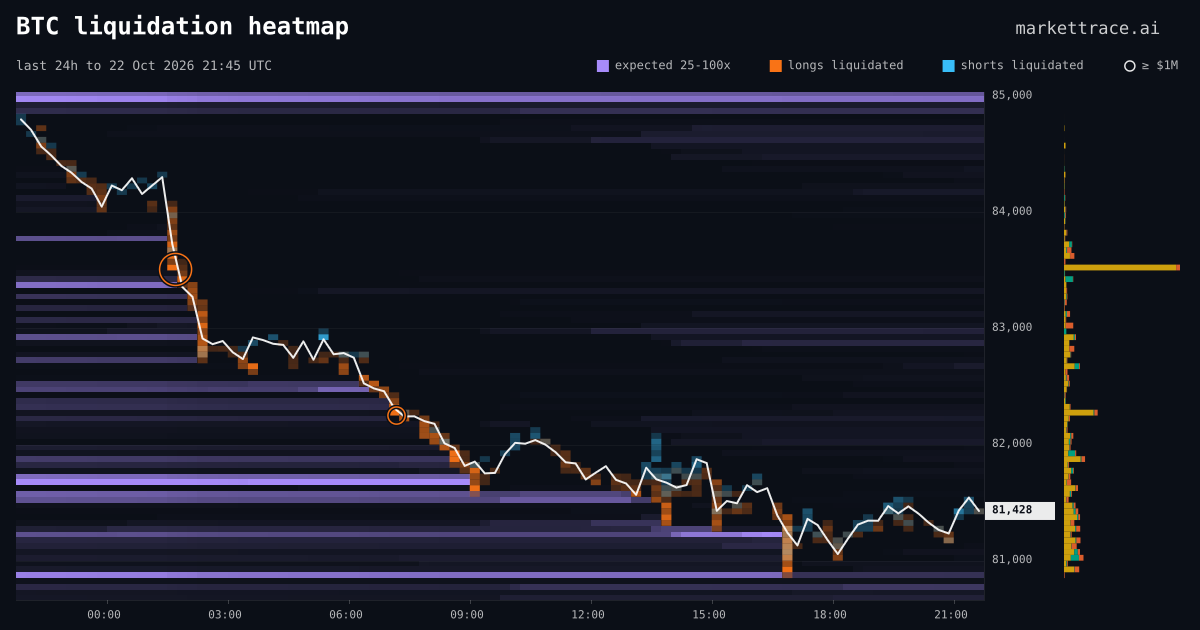
What follows is what a liquidation heatmap actually represents, how the math works, the four ways it gets misread, and a workflow that uses it as one input among several.
What a liquidation heatmap is
A liquidation heatmap is a forward-looking estimate of where leveraged perpetual positions would be force-closed at various leverage tiers. Time runs along the x-axis, price along the y-axis. Each cell is shaded by the estimated dollar value of liquidations that would fire if price reached that price level at that time.
It is not a record. A record of past liquidations is a liquidation tape, which is what MarketTrace shows live at /perpetuals/liquidations.
It is not a prediction. The heatmap does not say price will go to a hot zone. It says: if price went there, this much forced selling (or buying) would fire.
It is a map of forced liquidity. That is a real, useful, finite piece of information. The error is upgrading it to anything more.
How the math actually works
Most liquidation heatmaps follow the same recipe.
- Estimate open interest changes per asset. When OI grows, new positions are opening. When OI falls, positions are closing, voluntarily or by force. We measured what open interest actually predicts on six years of Binance data: the size of the next move, not its direction.
- Assume a distribution of leverage tiers. Common splits weight 10×, 25×, 50× and 100× positions. The exact weighting is provider-specific and rarely disclosed.
- Back out liquidation prices. For each entry-leverage combination, apply the venue's maintenance margin formula. A 10× long entered at the volume-weighted average price of a 5-minute window has a liquidation roughly 9% below entry on Binance.
- Aggregate to a price grid. Sum the dollar liquidations across all assumed positions at each price bucket per time slot. Render as colour.
Two heatmaps from two providers will not agree on cell values, because their leverage distributions differ. They will usually agree on the rough shape (where the dense bands sit), because OI prints are the same.
The math depends on assumptions that are not directly observable. That is fine. It is also why the output is a map, not a measurement.
Four ways a liquidation heatmap gets misread
Misread 1: as a price target. The biggest hot zone is not where price is headed. It is where leveraged positions would die if price went there. The heatmap is silent on whether price will go there.
Misread 2: as a guarantee of magnetism. Sometimes price clears liquidation pockets like clockwork. Sometimes it ignores them entirely and continues in the opposite direction. The heatmap shows potential liquidity to be eaten, not a force-field pulling price toward it.
Misread 3: as a substitute for the tape. A heatmap that says "$200M of long liquidations sit at $93,000" tells you nothing about whether the cascade is happening right now. The cross-exchange liquidations tape is what tells you that. Watch the tape for execution; watch the heatmap for potential.
Misread 4: as cross-venue truth. Coinglass's heatmap, Hyblock's, and others rely on each provider's OI inputs and leverage assumptions. They diverge in shape and intensity. A "hot zone" on one heatmap may be a dim band on another. Use the shape, not the absolute numbers.
Reading the heatmap well: the workflow
Step 1: identify dense bands at relevant timeframes.
A useful liquidation heatmap shades dense bands of leveraged positions sitting at specific price levels. On a 24-hour view, look for bands that are persistent (same colour intensity across multiple time slots) rather than transient (one or two cells). Persistent bands represent stacked leverage that has been there for a while. Transient bands are noise.
Step 2: cross-check with the resting order book.
If the heatmap shows a $50M long-liquidation cluster at $92,000 but the cross-exchange footprint chart shows almost no resting bids near $92,000, the liquidations would fall through air. They would accelerate the drop dramatically. Conversely, dense resting bids at the same level would absorb the cascade.
The combination of leverage on one side and resting liquidity on the other is what tells you whether a level is a magnet or a clean break.
Step 3: cross-check with funding rate and CVD.
A long liquidation cluster matters more when funding is positive and CVD is negative. Those are the conditions that produce sustained long pressure. When funding flips negative or CVD turns positive into the cluster, the longs are already getting out before liquidation, which means the cluster will be smaller than the heatmap predicts.
Use the funding scoreboard for the cycle context and the order flow quadrant for live CVD × OBI.
Step 4: watch the tape during the move.
If price approaches a heatmap cluster, switch attention to the live liquidation tape. Cascades print as tight clusters of same-colour dots within seconds. The size of those clusters confirms whether the predicted liquidity is actually firing or whether the leverage moved out before price arrived.
Step 5: act on confluence, not on the heatmap alone.
A trade idea that requires only "the heatmap shows a cluster at X" is a trade idea that fails roughly half the time. A trade idea that requires the heatmap cluster plus supportive funding, supportive CVD, supportive order-book context, and a sensible level on price is confluence. The heatmap is one input.
What MarketTrace shows about liquidations
MarketTrace publishes the live cross-exchange liquidation tape across Binance, Bybit and OKX (Hyperliquid does not broadcast individual liquidation events). The tape covers BTC, ETH, SOL, BNB, XRP, DOGE, HYPE, ZEC and ENA in real time with venue attribution and notional sizing.
The forward-looking liquidation heatmap product is not on MarketTrace today. The closest analogue is the combination of:
- Cross-exchange footprint chart — bid × ask volume per price level per 1m candle, with wall classification (absorbed vs spoof)
- Funding scoreboard — positioning context per venue
- Order flow quadrant — live OBI × CVD read
- Live liquidations tape — cascades as they happen
- BTC liquidation heatmap — expected levels from open interest, realized liquidations on the same grid
Together these answer "what would happen here" and "what is happening here" without requiring an opinion on inferred leverage tiers.
Bottom line
Read a liquidation heatmap as a map of inferred liquidity, not a price target. Cross-check with the order book, funding context and the live tape before acting on it. Treat the absolute dollar values as guidance, not measurements. Used as one input among four or five, it adds one specific signal: where forced liquidity could fire. That is useful. Treated as a standalone oracle, it produces the kind of magnet trades that look smart on a chart and fail in practice.
Related: What is liquidation in crypto? for the underlying mechanics, Order flow for the broader framework, Open interest, tested on 136,000 hours for why a growing OI is fuel rather than direction, Cross-exchange liquidations for the live tape.