Volume profile trading: how to read it and three ways to use it
How to read a volume profile: POC, value area, HVN/LVN, and three strategies adapted for 24/7 crypto perps. BTC examples, honest caveats.
A price chart tells you where the market went. A volume profile tells you where it did business.
That distinction sounds small. It isn't. Two candles can close at the same price after telling completely different stories: one drifted there on thin volume, the other fought through a wall of size. On a time-based chart both look identical. On a volume profile they look nothing alike: one leaves a trough, the other a peak, and each shapes how price behaves the next time it comes back.
This is the practical guide: how to read a volume profile, what the shapes mean, and three ways traders actually use it on crypto perpetual futures. If you want the history of where this family of tools comes from (Steidlmayer, the CBOT, the Market Profile of 1985), we covered that lineage in the footprint chart article. This one stays in the present.
The three numbers that matter
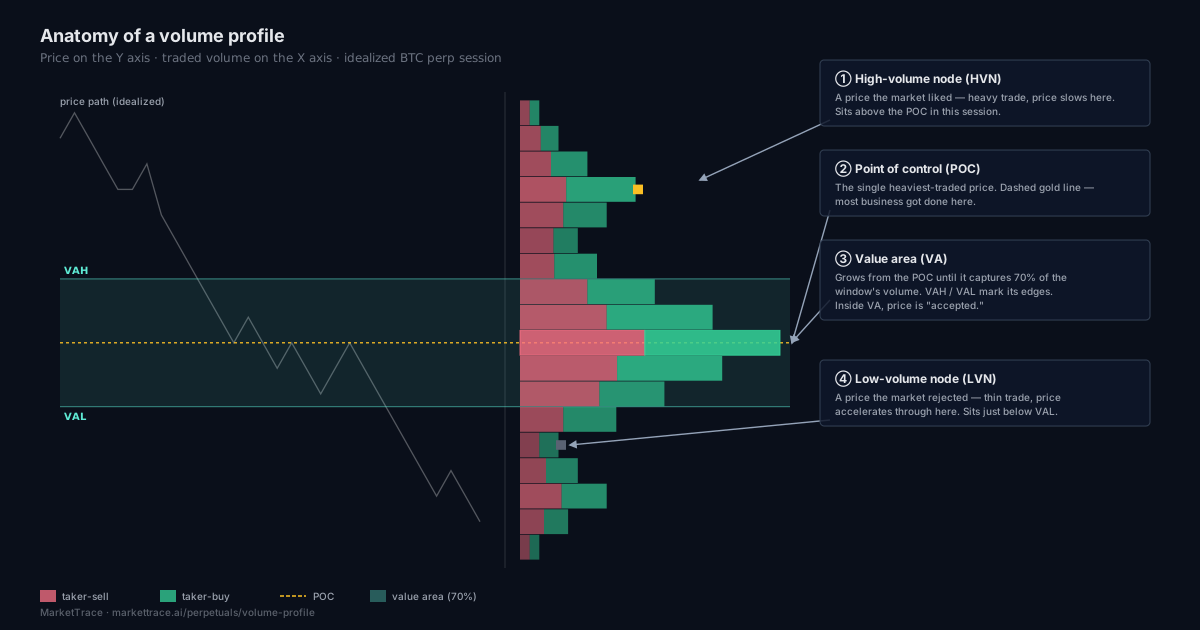
Rotate a volume histogram 90 degrees so it sits on the price axis, and you have a volume profile. Each horizontal bar is the total volume that traded at that price over the window you chose. That's the whole construction. Everything else is vocabulary.
Point of control (POC). The single price with the most traded volume in the window. This is where buyers and sellers agreed most often, where the most business got done. Price that trends away from the POC tends to get pulled back toward it, for a mundane reason: the level is dense with participants who transacted there and care about it. Positions were opened there. Stops cluster around it.
Value area (VA). Grow outward from the POC until you've captured 70% of the window's volume. The band you end up with is the value area; its edges are the value area high (VAH) and value area low (VAL). Why 70%? It's a rounding of the normal distribution: about 68% of a bell curve sits within one standard deviation of the mean. Steidlmayer's original Market Profile treated a trading session as a distribution-in-progress, and the convention stuck. Inside the VA, price is "accepted": the market agrees this is fair. Outside it, price is auctioning for acceptance at new levels, and reversion back into value is the statistically favored outcome in a balanced market.
HVN and LVN. Within the profile, local peaks are high-volume nodes and local troughs are low-volume nodes. An HVN is a price the market liked: it spent time there, transacted heavily, built memory. An LVN is a price the market rejected. It moved through fast and did little business. The asymmetry is the tradable part. Price entering an HVN tends to slow, chop, and stall. Price entering an LVN tends to accelerate, because there's nothing there: no memory, no defended positions.
Profile shapes, and what they say about the auction
A day's profile has a shape, and the shape summarizes the auction.
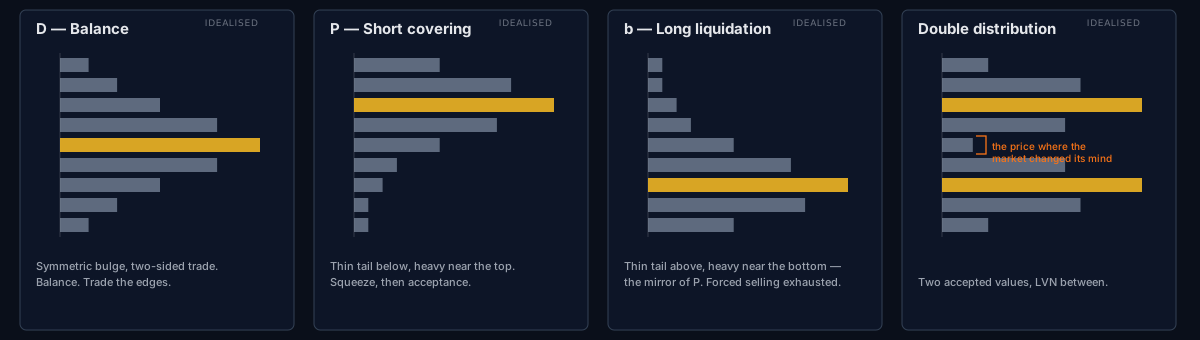
A D-shaped profile, fat middle and symmetric tails, is balance. Two-sided trade around an agreed value. Nothing to chase; the edges of the value area are the trade.
A P-shaped profile is heavy at the top with a thin tail below. Price spent little time at the lows and built value higher: typical of short-covering rallies, where the tail marks the squeeze and the bulge marks where shorts finished covering and trade normalized. A b-shaped profile is the mirror image: long liquidation, with the bulge at the bottom where forced selling exhausted itself.
A double-distribution profile has two distinct bulges separated by an LVN. The market accepted value at one level, repriced sharply, and accepted value at another. That connecting LVN is the most information-rich level on the chart: it's the price where the market changed its mind. Revisits of it tend to resolve fast, one way or the other.
A shape describes the day that already happened. A P-shape doesn't forecast anything by itself; it tells you what kind of auction you just watched, which constrains what the next session's open means. Context first, trade second.
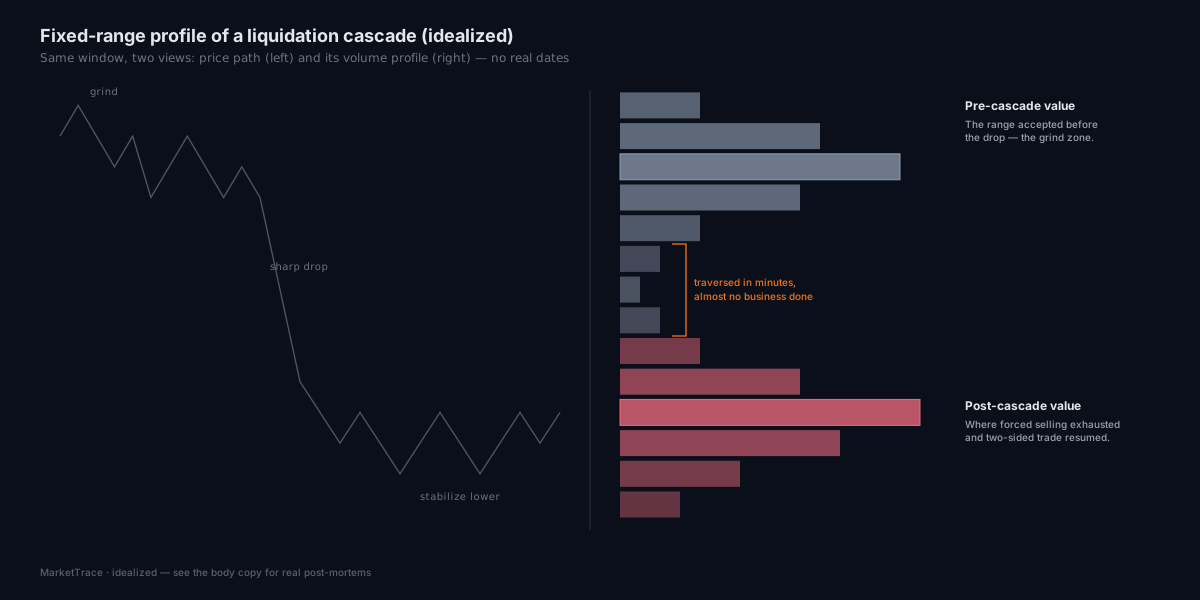
The forensic version of this shows up constantly in post-mortems of liquidation events: isolate the window with a fixed-range profile, and the two value areas plus the connecting LVN appear exactly like the diagram above. See the quiet crash post-mortem for a real one.
VPVR, session, fixed range, and the problem nobody mentions
Every platform ships the same three modes under slightly different names.
A visible-range profile (VPVR) builds from whatever bars are on your screen and recalculates as you scroll. Good default for context; dangerous if you forget that zooming changes the POC.
A session profile resets on a schedule and shows the current day's distribution as it develops: today's POC, today's value area, still forming.
A fixed-range profile anchors to a start and end you choose. This is the forensic mode: isolate one event (a cascade, say, or a squeeze) and see exactly where its volume concentrated. When we do post-mortems of liquidation events, fixed-range is the mode doing the work.
Here's the problem the futures literature never had to deal with: crypto has no session. The Market Profile canon is built on pit hours: an open, a close, an initial balance in the first hour, a value area per session. Every one of those concepts leans on the exchange bell. Perps don't ring one. BTC trades Saturday 3 a.m. the same as Tuesday 2 p.m., just thinner.
The industry's answer is convention: reset the session at 00:00 UTC and treat each calendar day as one distribution. It works, mostly, because enough participants anchor to the same convention that the levels become self-referential. But it means two things a futures trader never worries about. First, "yesterday's value area" is an arbitrary slice, not a natural auction unit: a move that started at 23:30 UTC gets split across two profiles. Second, weekend profiles are built on materially thinner volume, so a weekend POC deserves less respect than a Tuesday one. Treat session boundaries as a lens you chose, not a fact of the market.
MarketTrace's volume profile module resets sessions at 00:00 UTC and aggregates the tape across Binance, Bybit, OKX and Hyperliquid into one profile. A level that's heavy on all four venues is a different animal from one heavy on a single exchange's slice.
Strategy one: the POC retest
The simplest volume profile trade: price extends away from a heavy POC, momentum fades, and price rotates back to it. The POC acts as the magnet; your entry is the failure of the extension, and the POC is the target.
What makes this tradable rather than wishful is selectivity. A POC from a high-volume balanced day is a strong magnet. A POC from a thin, trending day is barely a level at all: the market never really agreed on it. And the strongest version of the trade uses a naked POC: a prior session's point of control that price has never revisited. Unfinished business. The market did its heaviest trade of that day there, moved away, and hasn't been back to test whether that price still attracts interest.
Naked POCs decay. A level from two days ago, with positions still open against it, pulls harder than one from three weeks ago that half the market has forgotten. The M5 module tracks the last 30 sessions and draws every untested POC as an orange line, with off-screen ones pinned to the chart edge with their distance, so the nearest piece of unfinished business is always visible.
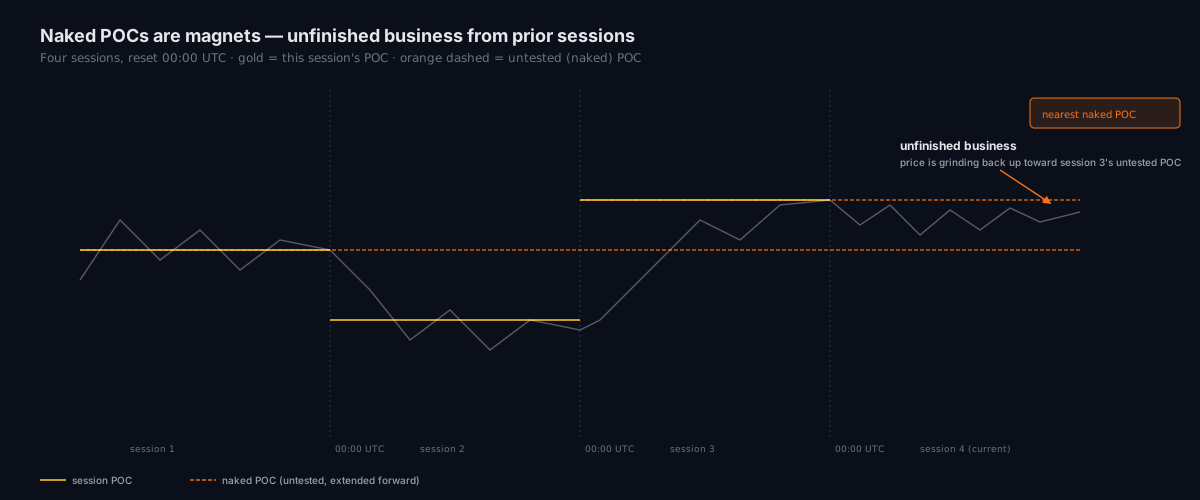
The failure mode: treating every POC touch as a reversal signal. The POC is a reference, a place where a reaction is more likely than elsewhere. Whether the reaction is a bounce or an acceptance-and-continuation is exactly what the profile cannot tell you, and what the order flow at the touch can. More on that below.
Strategy two: the LVN traversal
If HVNs are where price sticks, LVNs are where it slips. The second strategy is built on that asymmetry: when price breaks into a low-volume node with conviction, the path to the other side of the node is fast, because there is nothing in between to slow it down.
The setup wants three things. A well-defined LVN, ideally the gap of a double distribution, where the market repriced violently and left a vacuum. A directional push into it, confirmed by aggressive flow rather than drift. And a target on the far side: the next HVN, which is where the move should decelerate and where you should be reducing rather than adding.
This is the strategy most obviously improved by pairing the profile with a footprint. The profile says "if it breaks this trough, there's air until the next peak." The footprint says whether the break is real (stacked imbalances into the LVN, no absorption at the edge) or whether someone is passively eating the push, in which case the vacuum never gets traversed and the "breakout" was a top-tick sell to a patient counterparty.
The inverse trade exists too: price drifts into an LVN without aggression, stalls, and rotates back. Air pockets cut both ways. The node doesn't create direction; it amplifies whatever direction the flow brings into it.
Strategy three: value area rotation and the 80% rule
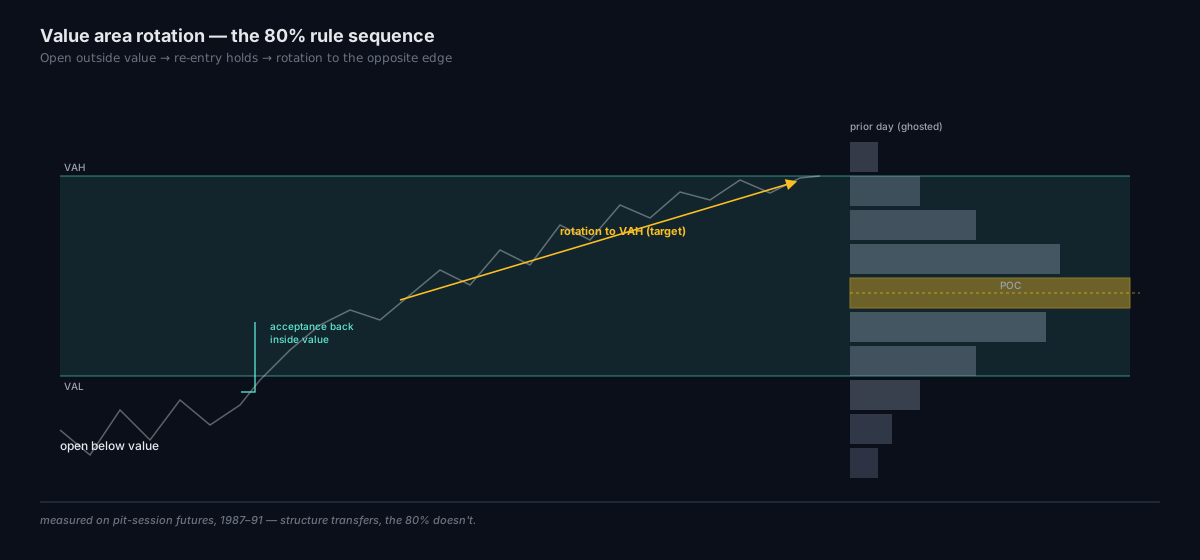
The classic session play. When price opens outside the prior day's value area and then trades back inside it, the odds favor a rotation across the entire value area to the opposite edge. The specific formulation, that two consecutive 30-minute periods inside the value area after opening outside it gives roughly an 80% chance of a full traversal, comes from the Profile Reports published by Dalton Capital Management between 1987 and 1991, and was popularized in James Dalton's Mind Over Markets. Traders have called it the 80% rule ever since.
The logic is auction theory, not numerology. An open outside value is the market probing for acceptance at new prices. Re-entry into the old value area is the probe failing. And a failed probe doesn't usually die at the edge. Participants who chased the open are now trapped, and their unwinding fuels the rotation across the range that the market already agreed was fair.
Now the honest part. That "80%" was measured on S&P futures with a pit session, a defined open, and 30-minute TPO periods. None of those exist on a BTC perp. There is no open to open outside of; the 00:00 UTC boundary is a convention, and nobody has published a rigorous crypto replication of the original statistic. What survives the transplant is the structure of the trade, not the number: price re-entering and holding inside a prior high-volume value area, after a failed excursion beyond it, tends to rotate toward the far edge. On crypto we'd suggest requiring the re-entry to hold on rising cumulative delta (CVD confirming that the rotation is being bought, not just drifting) before trusting the traversal target.
Anyone quoting "80%" to you about crypto perps is quoting a number measured on a different market in a different decade. The trade can still be good. The precision is borrowed.
Volume profile vs market profile, in one paragraph
You'll see both terms, sometimes interchangeably, and they're siblings rather than twins. Market Profile (capital letters, a CBOT trademark, under CME Group since the 2007 merger) organizes the session by time at price: each 30-minute block gets a letter, the letters stack into the famous TPO bell. Volume profile organizes by volume at price. In a pit-session market with uniform participation, the two mostly agree. In crypto, running 24/7 with no natural 30-minute rhythm and volume wildly concentrated around specific hours and events, time-at-price overweights the quiet ranging hours and underweights the violent ones. Volume-at-price is the metric that matches how perps actually trade, which is why nearly all crypto tooling, MarketTrace included, builds volume profiles. The concepts (POC, value area, balance, excess) transfer between the two frameworks intact.
What the profile can't see
The volume profile has one blind spot, and it's the same one every aggregated tool has: it collapses information to gain clarity.
It collapses time: a level that traded 5,000 BTC across three quiet weeks looks identical to one that traded 5,000 BTC in a violent hour. It collapses aggression: the default profile doesn't know whether volume at a price was buyers lifting offers or sellers hitting bids. (The M5 module's split mode restores half of this, dividing each bar into taker-buy and taker-sell volume.) And it says nothing about intent going forward: resting liquidity, the order book, the positioning backdrop.
So the profile answers "where are the levels?" and hands off every other question. Whether a level holds is order flow at the touch: absorption or traversal on the footprint. Whether the move into it is real participation is CVD. Whether the crowd is already leaning into the trade is funding and positioning. The profile is the map. It is not the traffic report.
That's also the order of operations we'd recommend learning: structure first (this article), then flow (the rest of the order-flow primer). Traders who learn flow without structure see signals everywhere and context nowhere.
FAQ
How do you read a volume profile?
Find the POC (longest bar), then the value area around it (70% of volume). Price inside the value area is trading at accepted levels; expect rotation between VAH and VAL. Price outside is auctioning for acceptance; expect either reversion back into value or, if acceptance builds, a new value area forming. Local peaks (HVNs) are levels where price slows; local troughs (LVNs) are levels it crosses quickly.
What timeframe is best for volume profile?
The profile isn't a timeframe indicator. It's built over a range, and the range should match the question. Session profiles (daily, reset 00:00 UTC in crypto) answer "where is today's value?" Fixed-range profiles isolate a specific event or swing. Visible-range gives context for whatever you're looking at. Intraday perps traders typically keep a session profile plus the prior day's levels; swing traders build fixed ranges over the structure they're trading.
Does the 80% rule work on crypto?
The original statistic, 80% odds of a full value-area rotation after re-entry, was measured on pit-session index futures in the late 1980s, using 30-minute periods and a true session open. Crypto perps have none of those. The auction logic behind the rule transfers; the precise probability doesn't, and no rigorous crypto replication has been published. Trade the structure, not the number.
What is a naked POC?
A point of control from a prior session that price hasn't traded back through since. Untested POCs mark unfinished business and often act as magnets when price finally approaches. They decay with age: a two-day-old naked POC carries more weight than a month-old one. The MarketTrace module tracks untested POCs across the last 30 daily sessions and draws them as orange lines.
Is volume profile the same as market profile?
No. Market Profile plots time-at-price (TPO letters, 30-minute blocks); volume profile plots volume-at-price. They share the vocabulary (POC, value area, balance) but weight it differently. On 24/7 crypto markets, volume-at-price is the more representative measure, because time-at-price overweights quiet hours.
Read a live one
Everything in this article is visible right now on the MarketTrace volume profile: BTC volume-by-price aggregated across Binance, Bybit, OKX and Hyperliquid, with POC, value area, HVN/LVN, buy/sell split, and naked POCs from the last 30 sessions marked automatically. Free, live, no account.
Sources
- Mind Over Markets: Power Trading with Market Generated Information — James F. Dalton, Eric T. Jones, Robert B. Dalton (Wiley)
- 80% Rule Definition — MyPivots trading dictionary
- Eighty Percent Rule — ShadowTrader glossary
- Market profile — Wikipedia
- Markets in Profile: Profiting from the Auction Process — James F. Dalton (Wiley)
- Intro to auction market theory and market profile — Topstep