Order flow trading: how to read the flow in crypto perpetual futures
What order flow trading is and how to read it in crypto perps: footprint charts, CVD, order book imbalance and absorption across Binance, Bybit and OKX.
Price tells you what happened. Order flow tells you who did it, how hard they pushed, and whether the move has anyone left behind it. That gap is the whole edge.
Order flow trading is the practice of reading the live stream of buy and sell orders, the volume traded at each price, and the resting orders in the book, to judge supply and demand before price has finished moving. Instead of waiting for a candle to close, you watch aggressive buyers lift offers and aggressive sellers hit bids in real time, and you trade the imbalance.
This guide is built for crypto perpetual futures: BTC, ETH, SOL and the rest of the perp tape across Binance, Bybit, OKX and Hyperliquid. The mechanics are the same ones futures desks have used for decades, but crypto adds three things that change how you read flow: 24/7 markets, funding instead of expiry, and liquidation cascades that turn forced selling into the loudest signal on the screen. By the end you will know what the tape, the footprint chart, cumulative volume delta, and order book imbalance each measure, how they fit together, and how to turn them into entries with a defined invalidation.
If you already know the basics, jump to order flow strategies or the footprint chart walkthrough.
What is order flow trading?
Order flow trading reads transactions and resting orders directly, rather than the indicators derived from them. A moving average smooths price. RSI transforms price. Order flow looks at the raw inputs underneath price: who traded, on which side, in what size, and where the unfilled orders are stacked.
Two order types create everything you see.
A market order crosses the spread to trade now. It is the aggressor. A market buy lifts the best offer; a market sell hits the best bid. Aggressors are willing to pay the spread because they want in or out immediately, so their footprint is the cleanest read on intent.
A limit order rests in the book and waits. It is passive liquidity. Limit buyers sit on the bid hoping price comes to them; limit sellers sit on the offer. The book is the supply of patience, and aggressors are the demand that consumes it.
Every trade is a market order hitting a limit order. The questions order flow answers are simple to state and hard to see on a normal chart: which side is crossing the spread, how much resting liquidity is absorbing them, and what happens when that liquidity runs out.
Three windows let you watch this:
- The time and sales feed, or "the tape": every print, with size and aggressor side.
- The depth of market (DOM), or order book: resting bids and offers at each price.
- The footprint chart: traded volume split into buys and sells at every price inside each candle.
People also call this order flow analysis, tape reading, or volume analysis. Same idea, different resolution.
Order flow vs price action and technical analysis
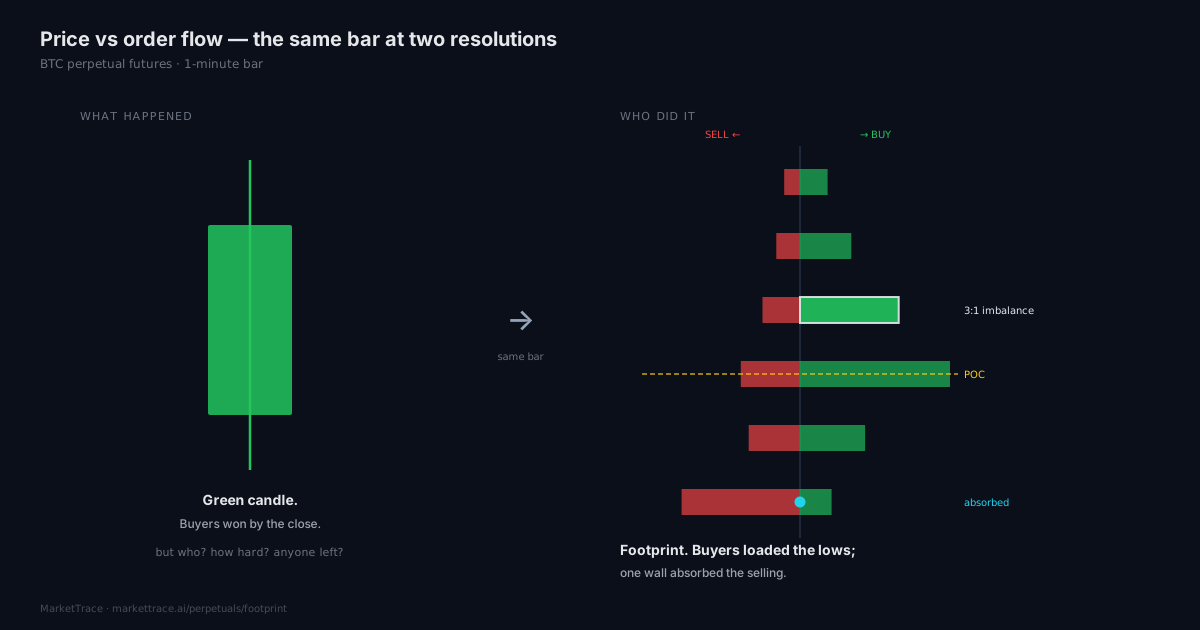
Classic technical analysis works on the four numbers a candle gives you: open, high, low, close. That throws away everything that happened inside the bar. A green candle tells you buyers won by the close. It does not tell you whether they won by overwhelming force or by a single late buyer nudging a thin book, and those two situations resolve in opposite directions.
Order flow keeps the inside of the bar. A green candle printed on heavy sell-side aggression that price absorbed is a strong bar. The same green candle printed on thin volume with sellers stepping away is a weak one that fades. Price action sees one candle; flow sees two different stories.
I am not arguing flow replaces structure. Support, resistance, ranges and trends still define where you care. Flow tells you what is happening at those levels: whether the bid at support is absorbing sellers or about to fold. Use structure to pick the spot, use flow to pull the trigger.
Why crypto perpetual futures are the best market for order flow (and the trickiest)
Almost every order flow guide online is written for CME futures or equities. The concepts port over, but if you trade crypto and follow that advice literally, you will misread the tape. Perpetual futures behave differently in four ways that matter.
No expiry, so funding replaces rollover. A perpetual futures contract never settles. To keep its price tethered to spot, exchanges charge a funding payment between longs and shorts, usually every eight hours (Hyperliquid runs hourly). Funding is the perp-specific mechanic that turns positioning into a cost. When funding is deeply positive, longs are paying to stay long, which is crowd-positioning information you simply do not get in dated futures. Read funding alongside flow, not instead of it.
Mark price and liquidations create forced flow. Positions are liquidated against a mark price, not last trade, and in crypto that leverage runs high. When price hits a cluster of liquidation levels, the exchange's engine starts market-selling (or buying) to close those positions. That is involuntary order flow, and it is violent. A liquidation cascade is the single most readable event in crypto: a wall of one-sided aggression that exhausts, then snaps back. Half of crypto order flow trading is just learning to read those moments.
The market is fragmented across venues. There is no single consolidated tape. Binance, Bybit, OKX and Hyperliquid each have their own book, their own flow, and their own liquidation feed. The same BTC candle can print net buying on one venue and net selling on another. Single-exchange flow is a partial view, and acting on it is one of the most common mistakes I see. More on aggregation below.
Spot and perps tell different stories. Perp flow is leverage-driven and fast; spot flow is slower and closer to real demand. When perps rip but spot does not follow, the move is positioning, not conviction, and it is fragile. Watching spot CVD against perp CVD is one of the higher-signal reads available, and it only exists because crypto splits the two.
The upside: crypto runs around the clock, the data is largely free and public, and retail leverage makes the order flow loud. The downside is everything above. This guide is written for that reality.
The crypto order flow toolkit
Order flow is not one chart. It is a small stack of views, each answering a different question. Here is the whole toolkit, then a section on how to read the two that do the heaviest lifting.
Footprint charts
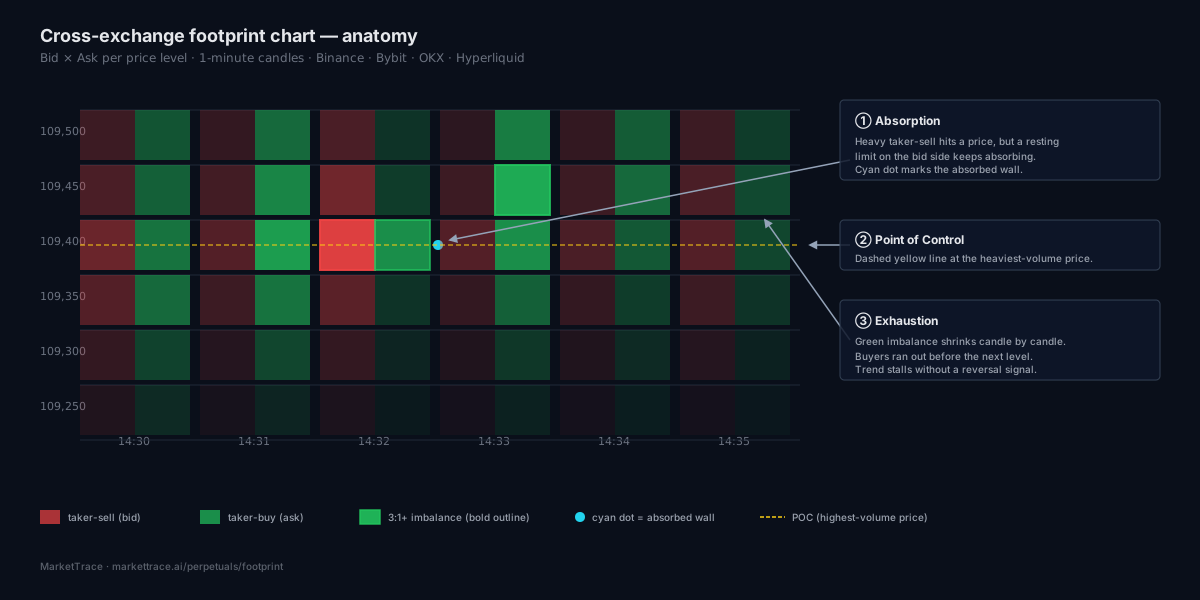
A footprint chart (also called a volume footprint chart, cluster chart, or numbers bars) takes each candle and splits the volume traded at every price level into buy-side and sell-side. Instead of a hollow candle body, you see a ladder of prices, and next to each price the volume that traded into the bid versus into the offer.
This is the highest-resolution view of order flow on a chart. It shows you exactly where inside a move the aggression happened: whether buyers were heaviest at the lows (accumulation) or chasing the highs (late, exhausted), and where sellers absorbed them. Most footprint tools also surface:
- Delta per level and per bar: buy volume minus sell volume.
- Diagonal imbalance: when buy volume at one price dwarfs sell volume at the price below it (or vice versa), flagged as a stacked imbalance.
- Point of control (POC): the price with the most traded volume in the bar, where the most business got done.
Footprint charts are available on TradingView, Sierra Chart, NinjaTrader, ATAS and Quantower, and a thinkorswim equivalent. Most of those are built for traditional futures; getting clean, aggregated crypto-perp footprint data is the harder part, which is the gap MarketTrace fills.
Volume profile
Where the footprint zooms into a single candle, volume profile zooms out: it's a histogram of traded volume at every price across a whole session or window, rotated onto the price axis. It answers a different question than the footprint — total volume at a price, not who was aggressive there. The point of control (POC), the value area, and high/low-volume nodes it produces are some of the stickiest reference levels on a chart. See the full breakdown, including how the pit-session playbook (the 80% rule, naked POCs) needs adapting for a market with no open and no close, in Volume profile trading: how to read it and three ways to use it.
Cumulative volume delta (CVD)
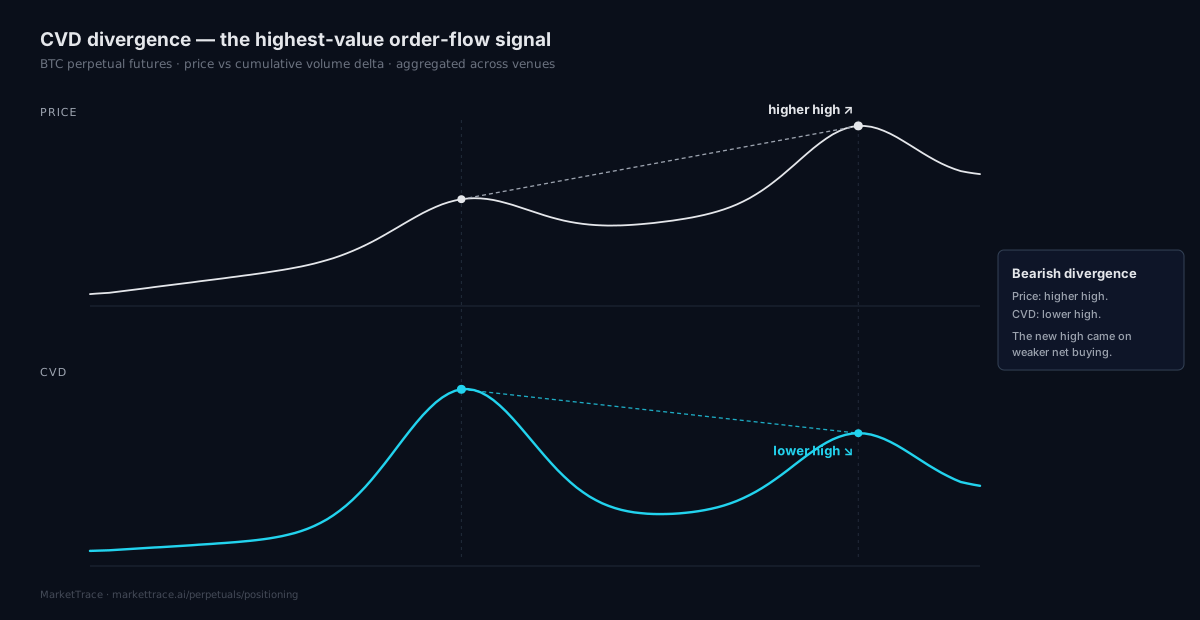
Cumulative volume delta is the running total of bar-by-bar delta (aggressive buys minus aggressive sells). Where the footprint zooms into one bar, CVD is the trend line of net aggression across many bars. Its most valuable signal is divergence: price makes a higher high while CVD makes a lower high, meaning the new price high was reached on weaker buying, a classic exhaustion warning. CVD is deep enough to deserve its own guide. See the full breakdown in Cumulative Volume Delta (CVD): the order-flow guide for perp traders.
Order book imbalance (OBI)
Footprint and CVD read trades that already happened. Order book imbalance reads intent that has not executed yet: the ratio of resting bid volume to resting offer volume in the book. A book stacked three-to-one on the bid side shows more passive demand than supply, a pressure that often precedes a move up, though it can also be spoofing (orders placed to be pulled). Pair OBI with delta to separate real resting demand from bluff. MarketTrace plots live OBI against CVD in its positioning quadrant, aggregated across venues so a single spoofed book is harder to hide behind.
Absorption and exhaustion
Absorption is the tell that turns flow into trades. It happens when heavy aggression meets a wall of passive orders and price does not move. Sellers keep hitting the bid, thousands of contracts trade, and price holds. That is a large limit buyer absorbing everything thrown at them, and when the sellers run out, price snaps up. Absorption trading is built on spotting that standoff. Exhaustion is the opposite edge of the same coin: aggression that fades while price stalls, the fuel running out at the end of a move.
Liquidations as forced flow
Liquidations are order flow you did not choose to send. A long liquidation is a forced market sell; a short liquidation is a forced market buy. Clustered, they cascade. Reading where liquidation levels sit, and watching the feed light up as price reaches them, tells you when a move is real demand versus an engine puking positions. We cover this in depth in the liquidations guide; for now, treat a spike in liquidations into a level as a likely exhaustion point, not a breakout to chase.
Funding and open interest as context
Funding and open interest are not flow themselves, they are the positioning backdrop that tells you what the flow means. Open interest rising into a rally means new money is opening positions (real participation); price rising while open interest falls means shorts covering (a squeeze that runs out of fuel). Funding tells you who is crowded and paying for the privilege. Neither triggers a trade alone, but both change how you weight what the tape is doing. Funding stays a "perpetual" word here because it only exists on perpetual contracts.
How to read a footprint chart, step by step
The footprint is where most traders get stuck, because it looks like a wall of numbers. It is not. Read it in four passes and it resolves quickly.
Take one bar. It is a vertical ladder of prices. At each price you see two numbers, conventionally sell volume × buy volume (volume that hit the bid on the left, volume that lifted the offer on the right).
Pass 1: find the point of control. Scan the bar for the price with the most total volume. That POC is where the bar's business got done. A POC near the high of an up-bar means buyers stayed aggressive all the way up; a POC near the low means most trading happened before the push, and the high was thin.
Pass 2: read the bar delta. Add up buys minus sells for the whole bar. Positive delta on a green bar is normal. The interesting cases are mismatches: a green bar that closed up on negative delta means more volume actually hit the bid than lifted the offer, and price rose anyway. Someone was absorbing the selling with limit buys. That is strength hiding inside a bar that looks unremarkable.
Pass 3: hunt stacked imbalances. Look for diagonal levels where one side is three or more times the other, several prices in a row. Stacked buy imbalances mark a zone aggressive buyers defended; those prices often act as support on a retest. Stacked sell imbalances do the reverse.
Pass 4: connect bars. One bar is a data point; the sequence is the signal. Rising price with shrinking buy delta bar over bar is the footprint of a move running out of buyers, the same exhaustion CVD divergence shows, at higher resolution.
Here is a simplified single-bar read on a BTC perp, ticks rounded for clarity:
| Price | Sell × Buy | Note |
|---|---|---|
| 64,120 | 18 × 240 | Stacked buy imbalance (offer lifted hard) |
| 64,100 | 30 × 410 | Stacked buy imbalance |
| 64,080 | 120 × 600 | POC (most volume in the bar) |
| 64,060 | 540 × 95 | Heavy selling absorbed, price held |
| 64,040 | 380 × 60 | Sellers aggressive at the low |
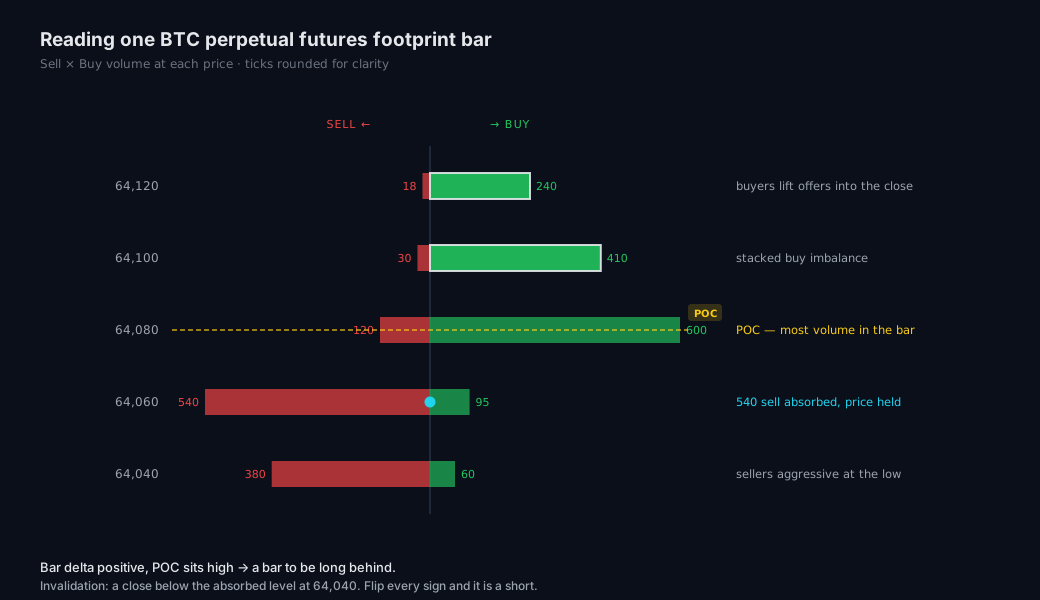
Bar delta is positive, the POC sits high, and the two top levels show buyers lifting offers into the close while the bottom shows sellers who got absorbed. That is a bar you want to be long behind, with invalidation below the absorption level at 64,040. Flip every sign and it is a short.
Order flow trading strategies: five setups
Flow is a lens, not a system. But a handful of setups recur often enough in crypto perps to trade with rules. Each one below has a trigger, a confirmation, and an invalidation, because a setup without an invalidation is just a hope.
1. Absorption at a level
The cleanest order flow trade. Price reaches a known level (range low, prior POC, a high-volume node). Heavy aggression hits it, the footprint shows hundreds of contracts trading on one side, and price does not move. That is absorption. Trigger: the aggression fades while price holds. Confirmation: bar delta flips and a few stacked imbalances print in your direction. Invalidation: a close beyond the absorbed level. You are betting the passive wall holds and the aggressors are trapped.
2. Delta divergence reversal
Price prints a higher high; CVD prints a lower high. The new extreme came on weaker net buying, so the move is thinning out. Trigger: the divergence forms at a level you already cared about. Confirmation: a footprint exhaustion bar (shrinking delta, POC rolling away from the high). Invalidation: CVD makes a new high with price, confirming the buyers came back. This is the highest-value pattern in the CVD guide and worth learning cold.
3. Liquidation sweep and reclaim
Crypto-specific, and one of the most reliable. Price wicks into a liquidation cluster, the liquidation feed spikes, forced sells dump price below a level, then it reclaims the level within a bar or two. The cascade was the bottom, not a breakdown. Trigger: liquidation spike into support plus a fast reclaim. Confirmation: delta flips positive on the reclaim bar; open interest drops (positions were flushed, not added). Invalidation: price stays below the swept level on rising sell delta. You are fading the forced sellers, not the market.
4. Breakout confirmation with delta
Most range breakouts fail. Flow filters them. When price breaks a range high, check whether delta and CVD are expanding with it. A breakout on strong, rising buy delta with stacked imbalances is real participation. A breakout on flat or negative delta is a liquidity grab that fades back into the range. Trigger: range break. Confirmation: delta expansion in the breakout direction. Invalidation: delta fails to confirm, price re-enters the range.
5. Spot-versus-perp conviction check
Not a standalone entry, a filter that keeps you out of fake moves. Before trusting a perp rally, glance at spot CVD. If perps are buying hard and spot is flat or selling, the move is leverage with no cash behind it, prone to a long squeeze. If spot CVD confirms, the move has real demand. Use it to size up the trades you already like and skip the ones running on leverage alone.
A note on timeframes: footprint and tape reading reward lower timeframes (tick, 1m, 5m) where individual bars carry information. CVD, funding and open interest work on any horizon. Match the tool to the trade.
A worked example: reading BTC perp flow through a long squeeze
Concepts stick when you watch them break someone. Early June 2026 gave a clean case. BTC had been grinding up on positive funding for days, open interest climbing, longs crowded and paying to hold. Classic late-trend positioning: the crowd leaning one way, funding flashing the cost.
When price slipped under a well-watched level, the liquidation feed lit up. Forced long liquidations sent market sells into a book that was already thin, and the cascade fed itself: each liquidation pushed price lower, triggering the next cluster. On the footprint, you would have seen bar after bar of heavy sell delta, POCs pinned to the lows, no absorption. That is the signature of forced flow, not informed selling. There is nobody to fade yet; the engine is still working.
The read is in what comes after. Once the liquidation spike peaks and the feed quiets, watch for the first bar that holds: sell aggression that stops moving price, delta flipping, open interest now lower than before the flush. That is the cascade exhausting. The traders who got hurt are the ones who shorted the bottom of the cascade, reading violent selling as conviction. The traders who got paid are the ones who recognized forced flow, waited for the absorption, and faded it. MarketTrace broke down the mechanics of one of these in the quiet crash investigation; the pattern repeats because leverage and liquidation engines do not change.
The lesson generalizes: in crypto, the loudest flow is often the least informed, because so much of it is forced. Your job is to tell forced flow from conviction flow, and the toolkit above is how you do it.
Single-exchange flow lies: aggregate across venues
Here is the mistake that quietly wrecks crypto order flow: reading one exchange and thinking you see the market.
There is no consolidated tape in crypto. If you watch only Binance, you are blind to the Bybit trader leaning the other way and the OKX book absorbing the move. The same one-minute BTC candle can show net buying on one venue and net selling on another, because flow is genuinely different on each. A CVD line built from a single exchange can diverge from price for reasons that have nothing to do with real positioning, just venue-specific noise.
Aggregated flow fixes this. When you sum delta and CVD across Binance, Bybit, OKX and Hyperliquid, venue noise cancels and the real imbalance shows through. A divergence that holds across all four venues is signal. A divergence on one is usually nothing. The same logic applies to the order book: aggregated bid-ask imbalance is far harder to fake than a single venue's, where one spoofer can distort the picture.
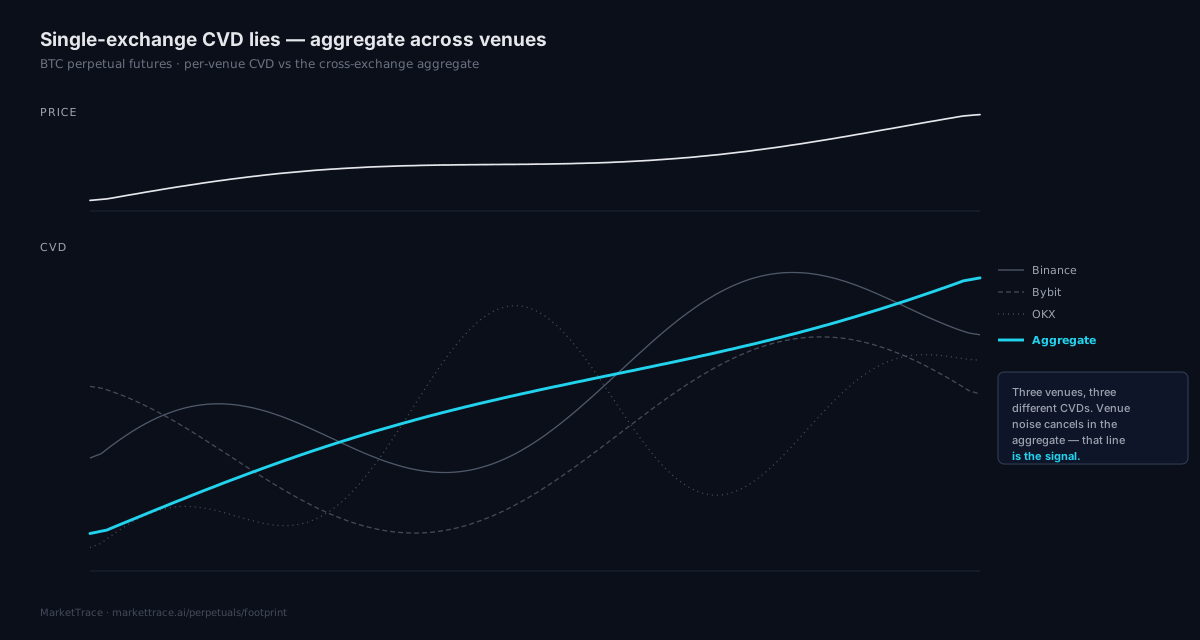
This is the core of what MarketTrace is built to show: cross-exchange microstructure for crypto perpetual futures, in one view, free and without a login. Most order flow platforms were built for single-venue traditional futures and bolt crypto on as one more symbol. In a fragmented market, that single-venue assumption is the flaw.
Common order flow trading mistakes
The errors are predictable, and most traders make all of them before they make money.
Trading flow without a level. Flow tells you what is happening; structure tells you where it matters. Aggression in the middle of a range is noise. Wait for it at a level you already cared about.
Reading one exchange. Covered above, and worth repeating because it is the most common. Single-venue flow is a partial view in a fragmented market.
Chasing the cascade. Forced liquidation selling looks like the most bearish thing you have ever seen, right before it reverses. Loud is not the same as informed.
Trusting the book at face value. Resting orders can be spoofed, placed to be pulled. A stacked bid that vanishes when price approaches was bait. Confirm book pressure (OBI) with executed flow (delta) before believing it.
Over-trading the footprint. Every bar has a story if you stare long enough. Most are noise. The footprint earns its keep at levels and at extremes, not on every candle.
Ignoring funding and open interest. Flow without positioning context misleads. The same buy delta means different things when funding is deeply positive and the crowd is already long versus when it is neutral.
Tools: where to get crypto order flow data
You need two things: a charting tool that renders order flow, and a clean source of aggregated crypto-perp data. Most products do one well and the other poorly.
| Tool | Footprint / tape | CVD | Aggregated cross-exchange | Crypto-perp native | Cost |
|---|---|---|---|---|---|
| TradingView | Footprint (paid tiers) | Yes | No (per-symbol) | Partial | Subscription |
| Sierra Chart / NinjaTrader | Deep footprint + DOM | Yes | No | Built for trad futures | Subscription + data |
| ATAS / Quantower | Strong footprint | Yes | Limited | Partial | Subscription |
| Exchange UIs | Basic tape + DOM | Sometimes | No (own venue only) | Yes | Free |
| MarketTrace | Footprint + flow | Aggregated CVD | Yes (Binance/Bybit/OKX/HL) | Yes | Free, no signup |
The traditional platforms are excellent at rendering flow and weak at aggregated crypto data. Exchange UIs are free but show you only their own venue. MarketTrace exists for the specific job the others skip: cross-exchange order flow for crypto perpetual futures, free and public. It is an observability tool, not a signals service. It shows you the plumbing and lets you draw your own conclusions.
Frequently asked questions
What is order flow trading?
Order flow trading is reading the live stream of executed trades and resting orders, the tape, the order book, and the footprint chart, to gauge real-time supply and demand before price finishes moving. It focuses on who is crossing the spread (aggressive market orders) and how much passive liquidity is absorbing them.
Does order flow trading work in crypto?
Yes, and crypto suits it well: markets run 24/7, the data is largely free and public, and high retail leverage makes the flow loud and readable. The catch is fragmentation. Because there is no consolidated tape, you should read flow aggregated across Binance, Bybit, OKX and Hyperliquid rather than trusting a single venue.
Is order flow trading profitable?
Order flow is an edge in execution and timing, not a complete system. Traders who pair it with clear levels and strict invalidation use it to enter earlier and risk less than candle-only traders. On its own, without structure and risk management, it is just more data. Profitability comes from the process around it.
What is the difference between order flow and volume?
Volume tells you how much traded. Order flow tells you which side was aggressive. A footprint chart splits the same volume into buys (offers lifted) and sells (bids hit), so you see net pressure, not just activity. Two bars with identical volume can have opposite delta.
What is the best order flow indicator?
There is no single best one; they answer different questions. The footprint chart is highest-resolution for one bar, cumulative volume delta (CVD) is best for trend and divergence across bars, and order book imbalance reads intent that has not executed yet. Most traders use all three together.
Footprint chart vs CVD: what is the difference?
A footprint chart shows buy and sell volume at every price inside a single candle, the microscope. CVD is the running total of net delta across many candles, the trend line. Use the footprint to read one bar in detail and CVD to see whether aggression is building or fading over time.
Can you do order flow trading on TradingView?
Yes. TradingView offers footprint charts and CVD on its paid tiers, but the data is per-symbol and per-exchange, so you do not get aggregated cross-exchange flow. For crypto perps specifically, single-venue flow can mislead; tools that aggregate across exchanges give a truer read.
Start reading the flow
Price is the summary. Order flow is the transcript. Once you can read the tape, the footprint, CVD and the book, you stop reacting to candles and start seeing the supply and demand that move them, especially in crypto, where so much of the flow is forced and the loudest moves are often the most fadeable.
The fastest way to learn is to watch live flow against price at a real level and see absorption, divergence and a cascade resolve in front of you. MarketTrace shows aggregated cross-exchange order flow for BTC, ETH, SOL, BNB, XRP and DOGE perpetual futures, free and without a signup. Open the positioning quadrant, pull up the footprint chart, and start reading.