The Fed Stopped Signaling. Crypto Leverage Stopped Positioning.
The Fed held rates, raised the dot plot and dropped forward guidance. A month later BTC funding sits mid-range and open interest is flat. The tape, read.
The first FOMC meeting of the Warsh Fed held rates, raised the dots and deleted the map. One month of derivatives tape says crypto leverage responded by refusing to play: funding pinned mid-band, open interest flat, a recovery built in spot.
On June 17, Kevin Warsh chaired his first FOMC meeting and did three things. He held the federal funds rate at 3.50–3.75%, the fourth consecutive hold, on a unanimous vote. He presided over a dot plot that moved the median year-end 2026 projection from 3.4% to 3.8%, which quietly converted the committee's base case from a cut to a possible hike. And he dropped forward guidance altogether: the Fed will no longer tell markets what it expects to do next.
The third decision is the one the crypto tape is still digesting a month later.
The immediate reaction was orderly and negative. Bitcoin came into decision day at $64,881, already down 2.6% on the session, and slid toward $63,000 after Warsh's press conference made clear that cuts were not coming. Total crypto market cap shed about $25 billion in the following 24 hours, to roughly $2.2–2.3 trillion. No cascade, no liquidation spike worth the name. For a market that had broken below $60,000 on June 5 in a crash with no catalyst, a 2% FOMC dip barely registered.
Then almost nothing happened. In funding terms, "nothing" is measurable.
What the dot plot actually changed
Since March, the committee's median projection sat at 3.4% for year-end 2026, half a step below the current range. Markets read that as one cut, eventually. The June dots moved to 3.8%, half a step above the current range: nine of eighteen participants now project at least one hike before year-end, six of them two. The accompanying PCE inflation forecast rose from 2.7% to 3.6%. Same committee, opposite lean, in one revision.
Warsh paired the revision with a communication change that got less coverage than it deserved. Forward guidance, in some form, had anchored Fed communication for decades. Its removal means every meeting is now live and every data print between meetings gets repriced against nothing. There is no stated path to trade against. Warsh himself declined to submit a dot while an internal review of the Fed's forecasting apparatus runs, a step with no recent precedent.
Rate markets showed what that does to positioning. June payrolls, released July 2, came in at a weak 57,000 against a consensus near 110,000. Hike odds rose anyway: the Polymarket-implied probability of a hike at the July 28–29 meeting doubled from 18% on July 2 to 36% by July 13, and CME FedWatch put the odds of a hike by July 29 as high as 46.5% mid-month. Then the trade unwound as fast as it built. By July 18, Polymarket prices a July hike at 4% and FedWatch near 10%. Odds swung by tens of points in each direction inside three weeks, with no Fed speech to steer them. That is what "no guidance" looks like in prices.
The crypto tape, one month on
Our 15-minute state archive starts July 3, so the two weeks of data below cover the aftermath, not the event itself. They are enough to describe the regime.
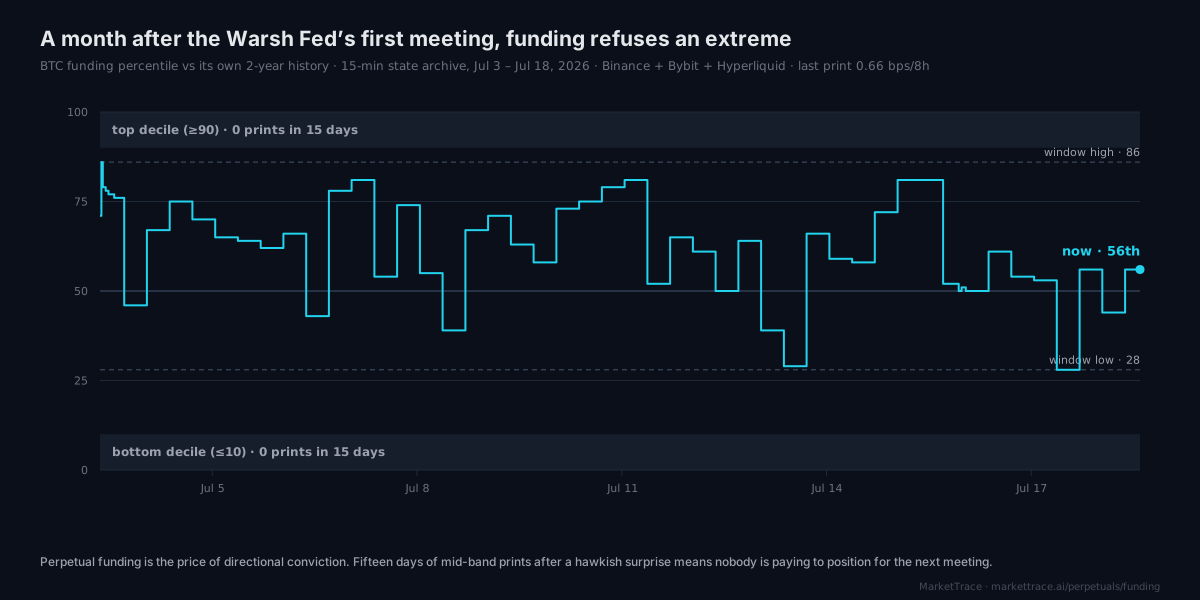
BTC funding percentile has spent the entire window inside a 28–86 band against its own two-year history. Not one print in the top decile. Not one in the bottom. As of July 18 the rate is 0.66 bps per 8 hours, the 56th percentile, which is another way of saying: dead median. We measured what extreme funding prints precede; the market is refusing to produce one.
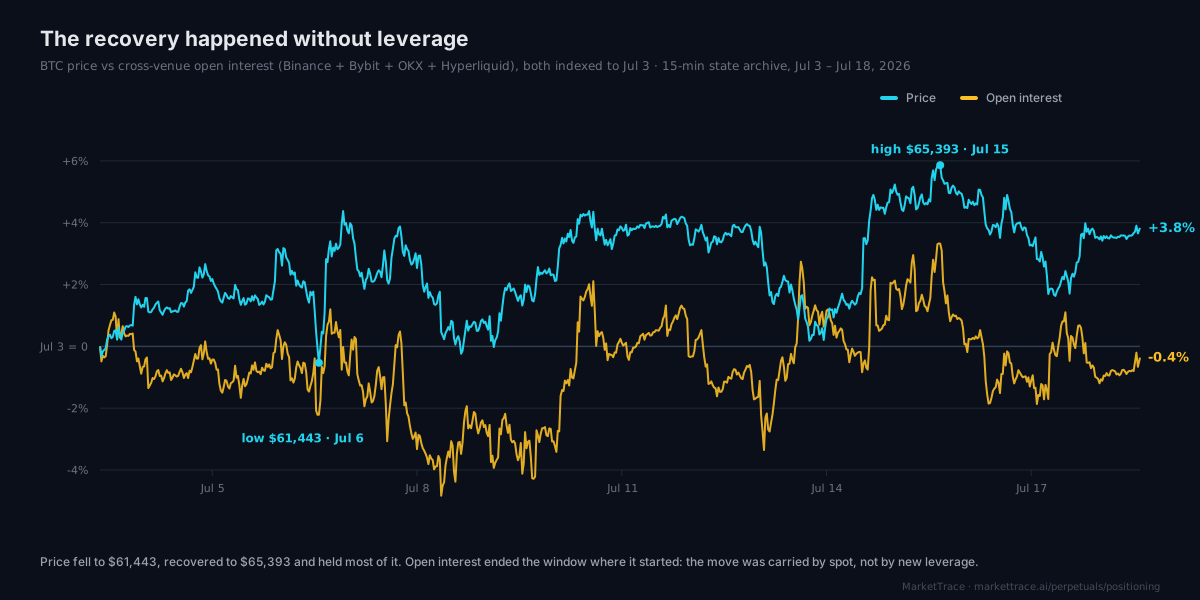
Open interest tells the same story from a different angle. Cross-venue BTC OI has oscillated between $13.8 billion and $15.0 billion across the whole window, with no trend: it ended the window 0.4% below where it started. Price, meanwhile, fell to $61,443 on July 6, recovered to $65,393 by July 15, and held most of it. A 6.4% price move with flat open interest means the move was not built on new leverage. The one OI push of the window, to $15.0 billion, arrived with the July 15 price high and unwound inside two days. Nobody added risk on the way up and kept it.
Taker flow confirms it. In our archive, net taker flow (measured over a rolling 30-minute window, sampled every 15 minutes) stayed inside ±$30 million in 86% of samples: small, alternating pushes with no sustained aggression in either direction. The largest single reading of the window was a $209 million net sell burst at 12:00 UTC on July 6, ninety minutes before the price low. It marked the bottom instead of starting a cascade.
This is the same pattern we documented in the Trump disclosure piece: a market that got burned in June and got sober. What is new is the plausible mechanism. When the Fed publishes a path, leverage can position against the path. When the Fed publishes nothing, positioning ahead of a binary meeting is a coin flip with a funding bill attached, and this market has already paid that bill twice this year.
Why mid-range funding is the story
Funding at the 56th percentile sounds like the absence of a signal. In this context it is the signal.
Perpetual funding is the price of directional conviction. When longs crowd, it prints high against history. When shorts crowd, it prints negative. A month of mid-band prints after a hawkish surprise, through a 40-point swing in hike odds, through a 6.4% price recovery, means the leveraged cohort has no conviction it is willing to fund. The spot-driven recovery happened without them.
The historical record says to respect that reluctance rather than mock it. In 789 days of cross-venue funding history, extreme prints on BTC carried real information: top-decile funding preceded a median 72-hour return of −1.18%. Mid-range prints carried close to none. A market pinned to its median is a market that has not yet made the mistake you can fade.
What to watch into July 28–29
The next meeting is the first live hike debate of this cycle, and the market enters it unpositioned. Three things on the tape will resolve faster than the statement text.
First, the funding percentile leaving its band. A push above the 80s into the meeting would mean longs finally paying to position for "no hike, dots soften". A drop toward the bottom decile would mean the hike trade is on. Either exit from the band ends the regime this article describes, and the base rates for what follows extremes apply from that point.
Second, where open interest builds. An OI expansion in the days before the meeting tells you leverage is picking a side early; the side is visible in whether funding moves with it. The window's one attempt, the build to $15.0 billion into the July 15 price high, unwound in two days. OI flat into the print means the reaction, whatever it is, will be spot-led and thinner books will carry it further.
Third, the liquidation map after the print. June 17 produced a 2% dip and barely any forced flow because there was little leverage left to force. If OI stays inside its July band into the meeting, the same dampening applies, in both directions. If it builds toward $16 billion first, the meeting has fuel.
If you are considering the short side of that meeting, we wrote a separate piece on how shorting crypto actually works and what it costs. The mechanics take a paragraph to learn; the funding bill and the squeeze risk take the rest of that article.
Method and coverage
Funding percentile, open interest and taker-flow figures are cross-venue aggregates (open interest and taker flow across Binance, Bybit, OKX and Hyperliquid; funding percentile against a 794-day history across Binance, Bybit and Hyperliquid, n = 2,382 samples), sampled from our 15-minute state archive between 2026-07-03T08:30Z and 2026-07-18T14:15Z. The archive postdates the June 17 meeting, so price and market-cap figures for the event window are from contemporaneous public reporting, and June 17 intraday levels vary by a few hundred dollars across sources. Every archived number can be re-derived from the public state history endpoint. This piece makes no forecast. It documents the positioning going into the meeting, the part most previews skip.
FAQ
Did the June 2026 FOMC meeting cause a crypto crash?
No. BTC fell about 2% on the decision, sliding toward $63,000 after the press conference, and total crypto market cap lost roughly $25 billion in 24 hours, to about $2.2–2.3 trillion. That is small against the June 5 break below $60,000 that preceded the meeting. There was no liquidation cascade, largely because the June deleveraging had already cleared most of the leverage that would have fueled one.
What did the Fed change at the June 2026 meeting?
Rates were held at 3.50–3.75% for the fourth consecutive meeting, on a unanimous vote. Two things changed: the median dot moved from 3.4% to 3.8% for year-end 2026, converting the committee's base case from a cut to a possible hike, and forward guidance was discontinued. The market now reprices every data release without a stated Fed path, which is why July hike odds swung from 18% to 46.5% and back to single digits inside three weeks.
What does flat open interest with rising price mean?
The move is happening in spot, not in leverage. Between July 3 and July 18, 2026, BTC recovered 6.4% from its low while cross-venue open interest stayed inside a $13.8–15.0 billion band and ended the window where it started. Nobody added leveraged risk on the way up, which also means fewer forced sellers on dips and less fuel for squeezes in either direction.
Related
- The Crypto President Got Paid. The Market Got Sober. → the sober-tape thesis this post extends: a market that stopped paying for narratives.
- The quiet crash: Bitcoin below $60K → the June deleveraging that emptied the market of leverage before Warsh ever spoke.
- Extreme funding rates: what 789 days of data actually show → the measured base rates that apply the moment funding leaves its band.
- What does a negative funding rate mean? → the sign convention behind "a drop toward the bottom decile means the hike trade is on."
Sources
- Federal Reserve: FOMC meeting calendars, statements and projections
- Bitcoin Dips, Altcoins Plunge: Full Impact of June 2026 FOMC Meeting on Crypto — The Crypto Times
- BTC, ETH, BNB, XRP, SOL Slip Ahead of Warsh's First FOMC — The Crypto Times
- Crypto markets wobble after hawkish Fed outlook in Kevin Warsh's first FOMC meeting — The Block
- Bitcoin Falls After Warsh's Hawkish Dot Plot Signals 2026 Rate Hike — Blockchainreporter
- Warsh's Debut "Abandons Forward Guidance"; Cryptocurrencies Plunge — TradingKey
- A July rate hike from the Fed? The odds are rising — CNBC
- June US Jobs Report: 57,000 Rise in Payrolls, Below Forecasts — Morningstar
- Fed decision in July? — Polymarket
- CME FedWatch Tool — CME Group
- Crypto market cap charts — CoinGecko